

How to Find the Right GM Part Number Using Your VIN
TL;DR
Your GM vehicle’s VIN is the most reliable starting point for finding the correct OEM part number. A VIN helps narrow parts by year, make, model, engine, trim, drivetrain, and factory options, which matters because many Chevrolet, GMC, Buick, and Cadillac parts can look similar but fit differently. Use the GM Parts Center VIN Decoder, then confirm the part category, fitment notes, and vehicle details before ordering.
Why Your VIN Matters When Buying GM Parts
Finding the right GM part number should not feel like a guessing game. If you own a Chevrolet Silverado, GMC Sierra, Cadillac Escalade, Buick Enclave, or any other GM vehicle, you may see several parts that appear to match your repair. The challenge is that GM often uses different part numbers based on engine size, production date, trim package, electrical options, body style, or drivetrain.
That is why learning how to find the right GM part number using your VIN is one of the smartest steps you can take before ordering replacement parts. Your VIN is a 17-character vehicle identifier that helps connect your exact vehicle configuration to the correct OEM catalog data. GM Parts Center offers search by part number, keyword, or VIN, along with a VIN decoder designed to help confirm fitment before you shop. :contentReference[oaicite:0]{index=0}
The Problem With Searching by Year, Make, and Model Alone
Year, make, and model are helpful, but they may not be specific enough. A single model year can include multiple engines, transmissions, axle ratios, brake packages, cooling systems, and interior or exterior options. For example, two GM trucks from the same year may use different brake components, oxygen sensors, fuel system parts, or electrical connectors depending on equipment.
This is where a GM part number lookup by VIN becomes useful. Instead of starting with a broad catalog search, your VIN helps narrow the results to the parts designed for your vehicle’s factory build. That can reduce the risk of ordering a part that looks right online but does not install correctly once it arrives.
How VIN-Based GM Part Lookup Works
Your VIN gives parts specialists and online catalog tools a clearer picture of your GM vehicle. Depending on available data, it can help identify details such as the model, trim level, engine, and other vehicle specifications. GM Parts Center notes that its VIN decoder can help determine information ranging from trim level to fuel tank capacity, while the site’s catalog lets shoppers search by VIN for fitment support. :contentReference[oaicite:1]{index=1}
In practical terms, VIN-based lookup helps answer one important question: “Which version of this part fits my exact GM vehicle?” That is especially important for parts tied to emissions, braking, cooling, electrical systems, and body hardware.
Step-by-Step: How to Find the Right GM Part Number Using Your VIN
1. Locate Your VIN
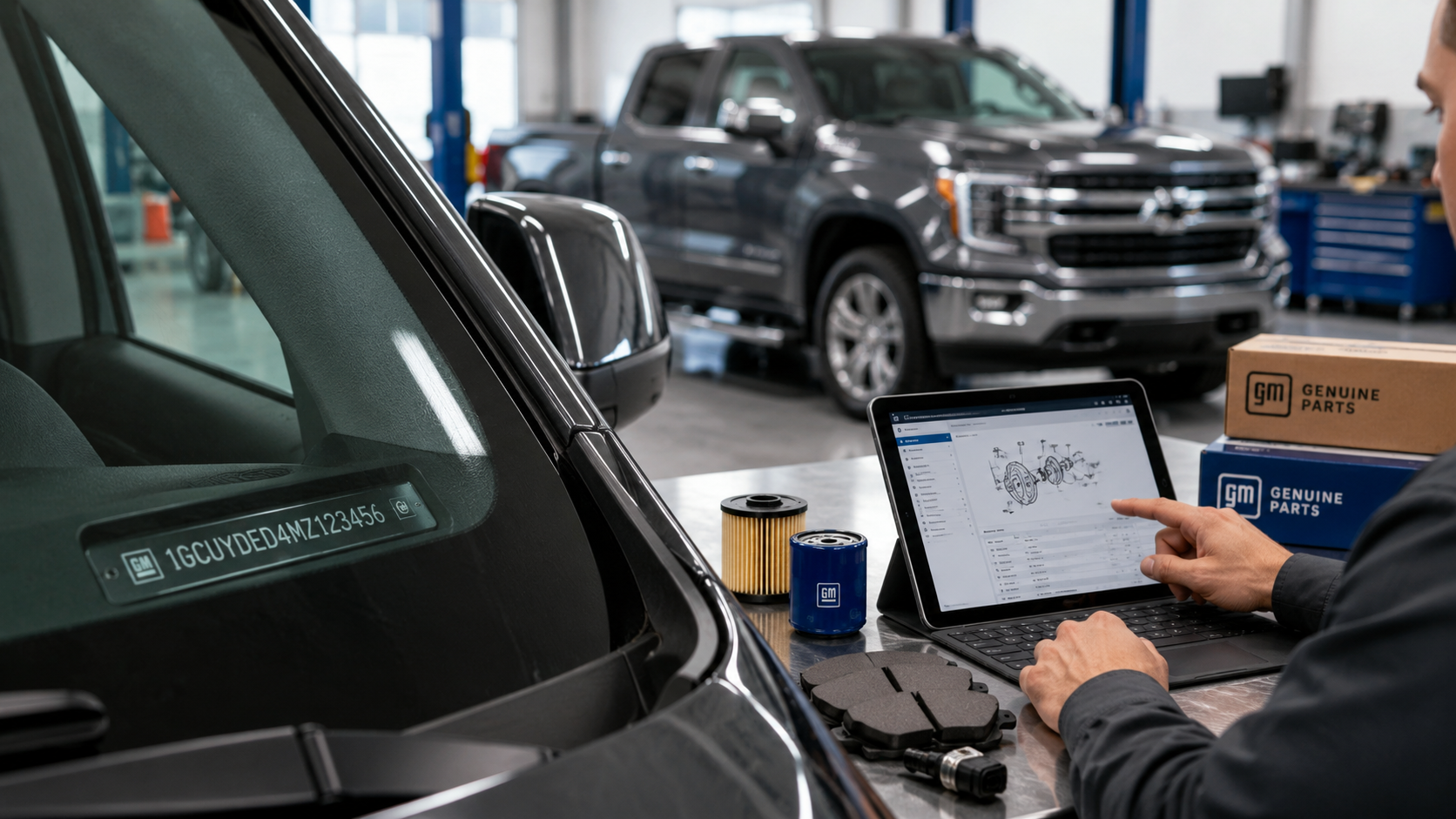
Start by finding your 17-character VIN. Common locations include the driver-side dashboard near the windshield, the driver-side door jamb label, vehicle registration, insurance card, or title. Double-check every character, especially numbers and letters that are easy to confuse.
2. Use a GM VIN Lookup Tool
Enter your VIN into the GM VIN Decoder or use the site search field that accepts part numbers, keywords, or VINs. This helps connect your vehicle information with the GM parts catalog.
3. Search by Part Category or Keyword
Once your vehicle is identified, search for the repair area you need. GM Parts Center organizes OEM factory parts into categories such as air filters, alternators, belts, brake pads, fuel pumps, oil filters, oxygen sensors, radiators, starters, thermostats, water pumps, and window regulators. :contentReference[oaicite:2]{index=2}
4. Review Fitment Notes
Do not stop at the first matching result. Read product names, fitment notes, and any option-specific details. A part may depend on engine code, body style, emissions package, or whether the vehicle has a specific factory option.
5. Compare With the Existing Part When Possible
If the old part is accessible, compare its number, connector shape, mounting points, and physical design. This is helpful for sensors, modules, trim pieces, and older GM vehicles where catalog data may have limitations.
6. Ask for Help Before Ordering
If you are unsure, contact the GM Parts Center parts team before purchasing. This is better than guessing, especially for special-order, electrical, painted, or vehicle-specific components.
Recommended GM Parts Categories to Shop by VIN
VIN lookup is useful for almost any repair, but it is especially helpful for categories where small differences matter. For regular maintenance, start with GM air filters, GM oil filters, and GM fuel filters. These parts help support proper engine performance and should match the vehicle’s engine and service requirements.
For safety and drivability repairs, VIN confirmation is valuable when shopping for GM brake pads, brake rotors, suspension parts, and steering components. Brake systems can vary by wheel size, trim, towing package, or performance package.
For diagnostic repairs, use VIN-based searching when buying GM oxygen sensors, fuel pumps, alternators, starters, and electrical parts. These parts often depend on engine family, emissions configuration, and connector design.
For broader browsing, use the All Parts and Accessories page to narrow your search by category. GM Parts Center lists many OEM part and accessory categories in one place, making it easier to move from a VIN-confirmed vehicle search into the exact repair area you need. :contentReference[oaicite:3]{index=3}
Why Choose OEM GM Parts?
OEM GM parts are built to match the fit, function, and design intent of your GM vehicle. That matters when you are replacing components that affect safety, emissions, performance, comfort, or long-term reliability. Aftermarket parts may fit a range of vehicles, but OEM parts are designed around GM specifications.
For GM owners who want the repair to be straightforward, using the VIN and choosing OEM parts is a practical combination. The VIN helps identify the correct part number, and the OEM part helps preserve factory-style fit and performance.
Key Takeaways
- Your VIN is the best starting point for finding the right GM part number.
- Year, make, and model searches can miss important trim, engine, and option differences.
- Use VIN lookup before ordering parts like brake pads, sensors, filters, fuel pumps, alternators, and electrical components.
- Always review fitment notes before checkout.
- When in doubt, ask a GM parts specialist to verify compatibility before ordering.
FAQ
Can I find a GM part number with only my VIN?
Yes, your VIN can help narrow the correct OEM GM part number for your exact vehicle. You may still need to choose the correct category or confirm fitment notes, especially when multiple related parts are listed.
Where is my GM VIN located?
You can usually find it on the driver-side dashboard near the windshield, the driver-side door jamb label, your registration, insurance card, or title.
Why do multiple GM part numbers show up for the same vehicle?
Different engines, trims, production changes, body styles, and factory options can require different parts. That is why VIN lookup is more accurate than browsing by model alone.
Should I use the old part number or my VIN?
Use both when possible. The old part number is useful, but your VIN helps confirm whether that part is correct for your exact GM vehicle or if it has been replaced by an updated number.
What GM parts should I always verify by VIN?
Verify parts such as brake components, oxygen sensors, fuel pumps, alternators, starters, electrical parts, cooling parts, body trim, and anything tied to engine, emissions, or factory options.